November 25, 2025
Car Spray Booth: Definition, Core Functions, and Mainstream Classifications
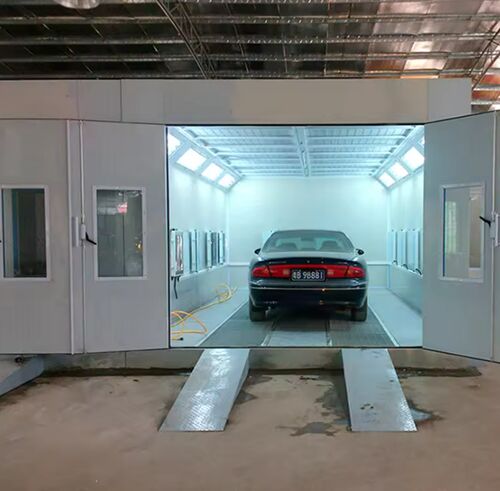
A specialized facility designed to provide a closed, clean, temperature- and humidity-controlled environment for automotive painting operations. It uses a filtration system to remove airborne contaminants and a ventilation system to control the spread of paint mist (overspray), ensuring paint quality and operator safety. It is a critical facility in the automotive repair, modification, and manufacturing sectors.
① Quality Assurance:
Prevents dust and impurities from adhering to the paint surface.
Reduces defects such as runs and particulate contamination, ensuring a smooth and level finish.
② Safety Protection:
Lowers the concentration of VOCs (Volatile Organic Compounds) through paint mist collection devices (e.g., activated carbon filtration, water curtain purification).
Prevents operators from inhaling harmful fumes.
③ Efficiency Improvement:
The controlled environment with constant temperature (typically $20text{–}25^circtext{C}$) and humidity ( $40% text{–} 60%$) accelerates paint drying time, boosting the efficiency of the painting operation.
Electric Heating Spray Booth: Suitable for small auto repair shops; fast heating and relatively low energy consumption.
Oil/Gas Heating Spray Booth: Suitable for large-scale facilities; higher heating power and ideal for low-temperature regions.
Dry Spray Booth: Uses filter media (e.g., filter cotton) to absorb paint mist; simple maintenance.
Wet Spray Booth: Uses a water curtain to capture paint mist; high purification efficiency, suitable for high-throughput/high-production scenarios.
Standard Type: Suitable for passenger cars (sedans).
Large-Scale Spray Booth: Suitable for larger vehicles like SUVs, trucks, and vans.
Customized Type: Designed for the special dimensional requirements of modified or unique vehicles.